

The complete guide
Downpipe Leaf Guards, A Practical Buyer's Guide
The problem nobody notices until it rains hard
Most gutter trouble starts in one small spot. Not along the whole length of the gutter, but right where the gutter floor opens into the downpipe. That hole is usually somewhere between 40mm and 100mm across, and it is the narrowest point in the entire drainage path.
Leaves wash along the gutter in the first few minutes of rain. They reach the outlet, a few get pulled in sideways, and they jam. Then grit, roof granules, moss and seed pods pack in behind them. Within one season you have a plug.
You often do not find out until a heavy downpour. The gutter fills, water comes over the front lip in a sheet, and it lands wherever gravity takes it. Against a wall. Into a garden bed that then erodes. Down the side of a window frame. If the overflow runs towards the house rather than away, you get damp at the base of the wall and you start worrying about things that cost real money to fix.
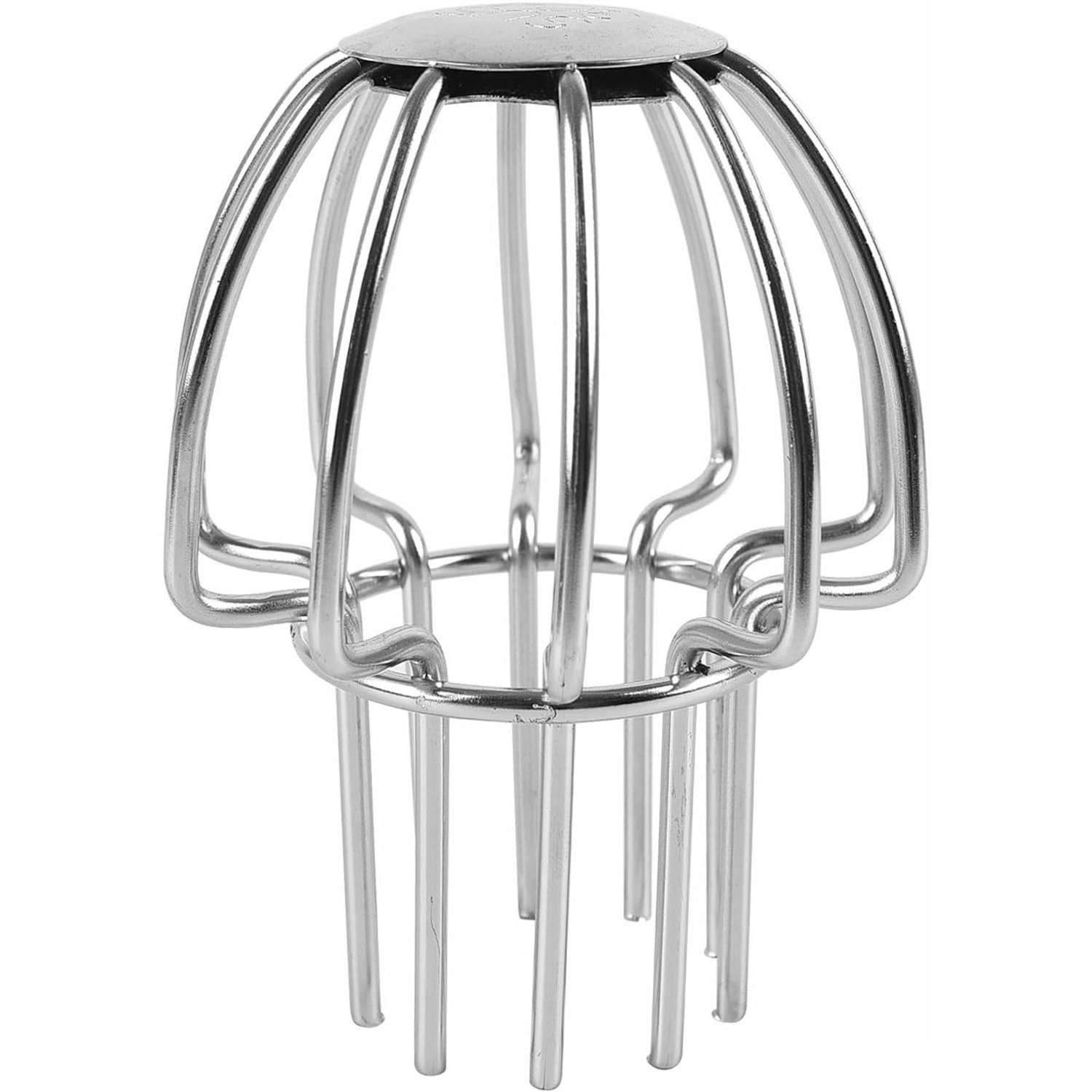
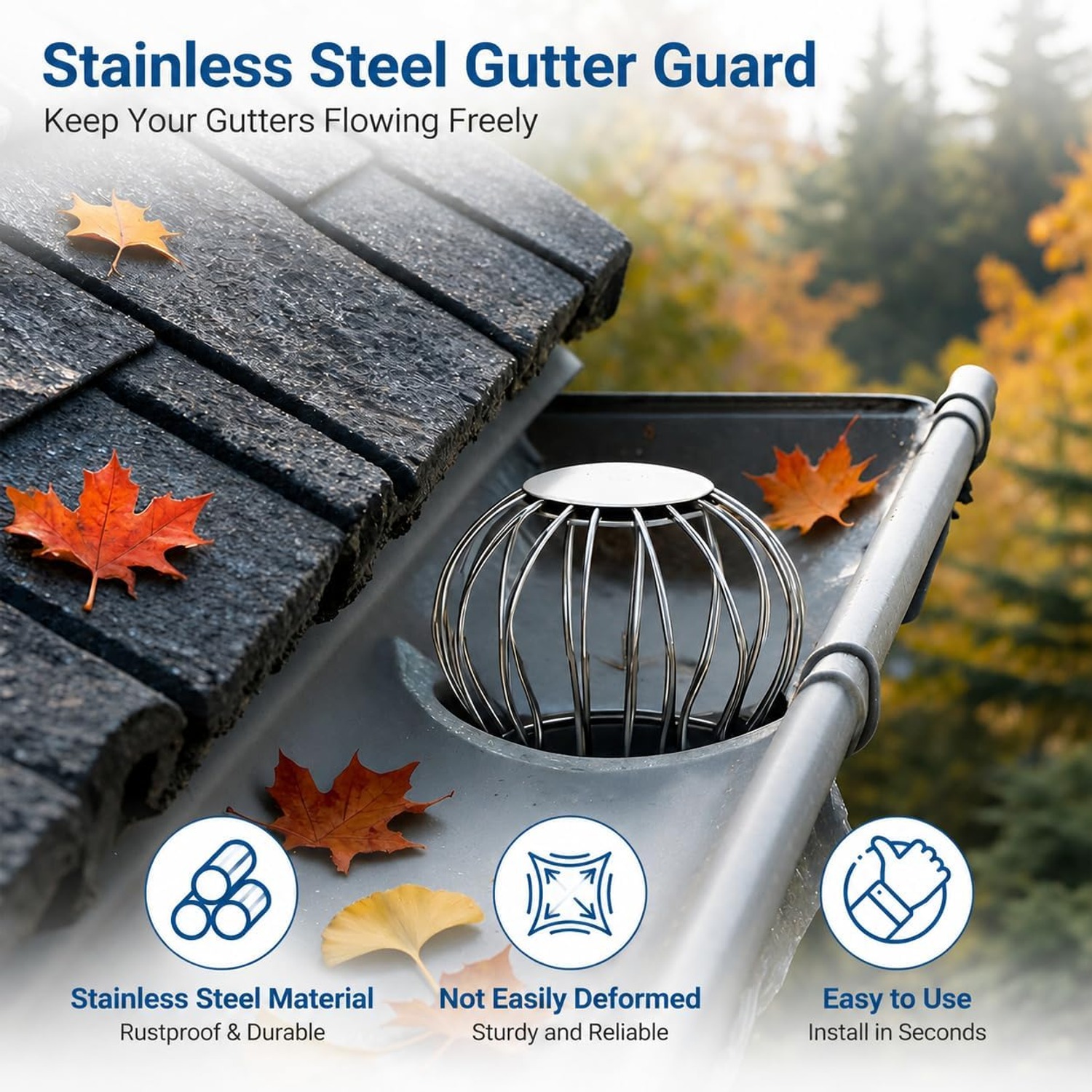
A stainless steel downpipe leaf guard sits in that exact spot and refuses entry. It does not stop leaves landing in the gutter, but it stops them going down the pipe, and that is the part that causes the damage.
How the dome shape works
The first thing to understand is why these guards are domed rather than flat.
A flat screen over a drain hole has exactly the surface area of the hole. The moment leaves cover it, the water has nowhere to go. You have swapped a blocked pipe for a blocked screen, and the overflow happens anyway.
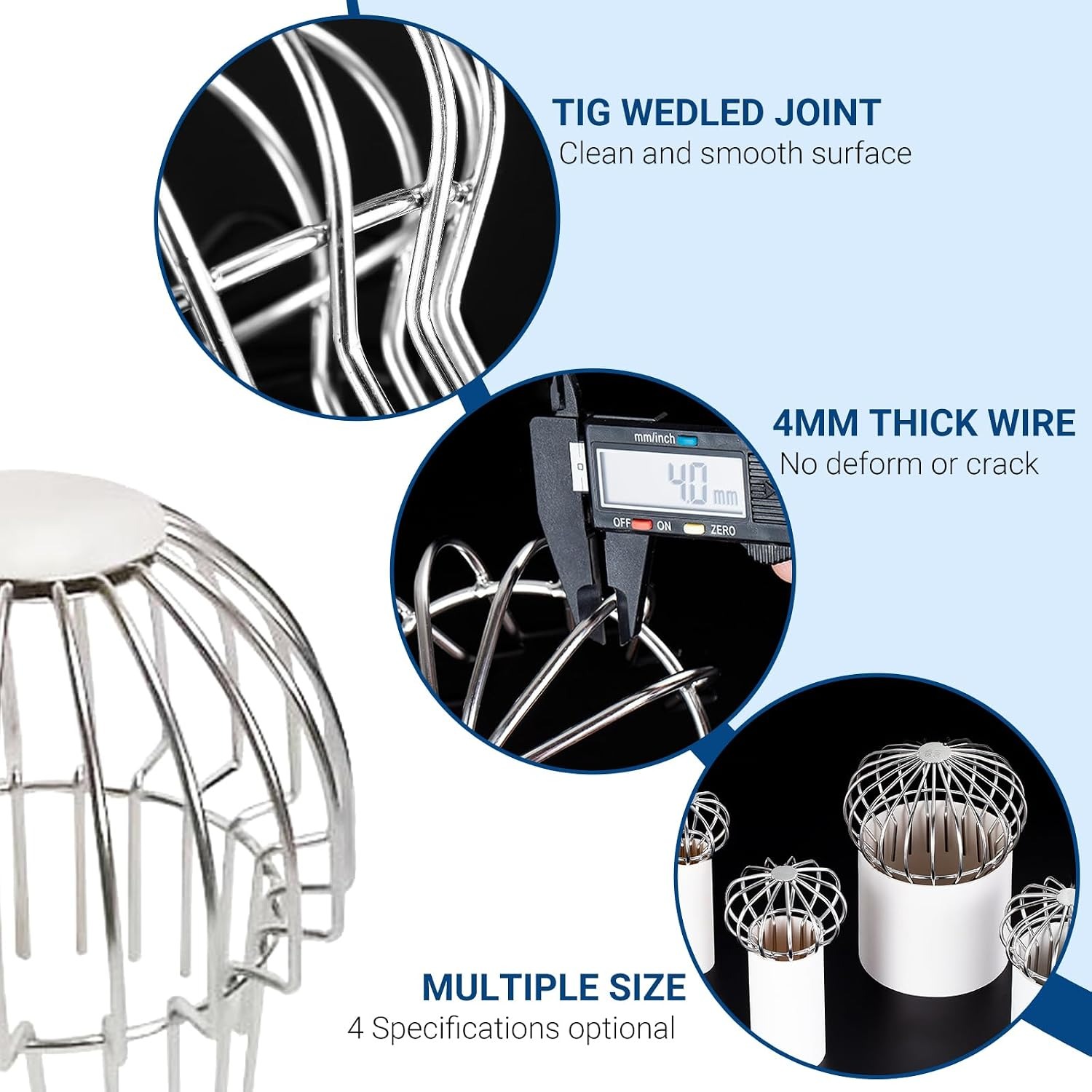
A dome lifts the mesh well above the opening and multiplies the usable surface. Leaves land on the top and the curved sides, but water finds a path through whatever part of the mesh is still clear. Even with a decent cap of debris sitting on it, rain keeps draining through the lower half. That buys you time between cleans, which is the whole point of fitting one.
The mesh openings are sized to let water and fine grit through while holding back the material that actually causes blockages. Twigs, gum leaves, pine needles, seed pods and nesting material all stay on the outside.
Why stainless steel
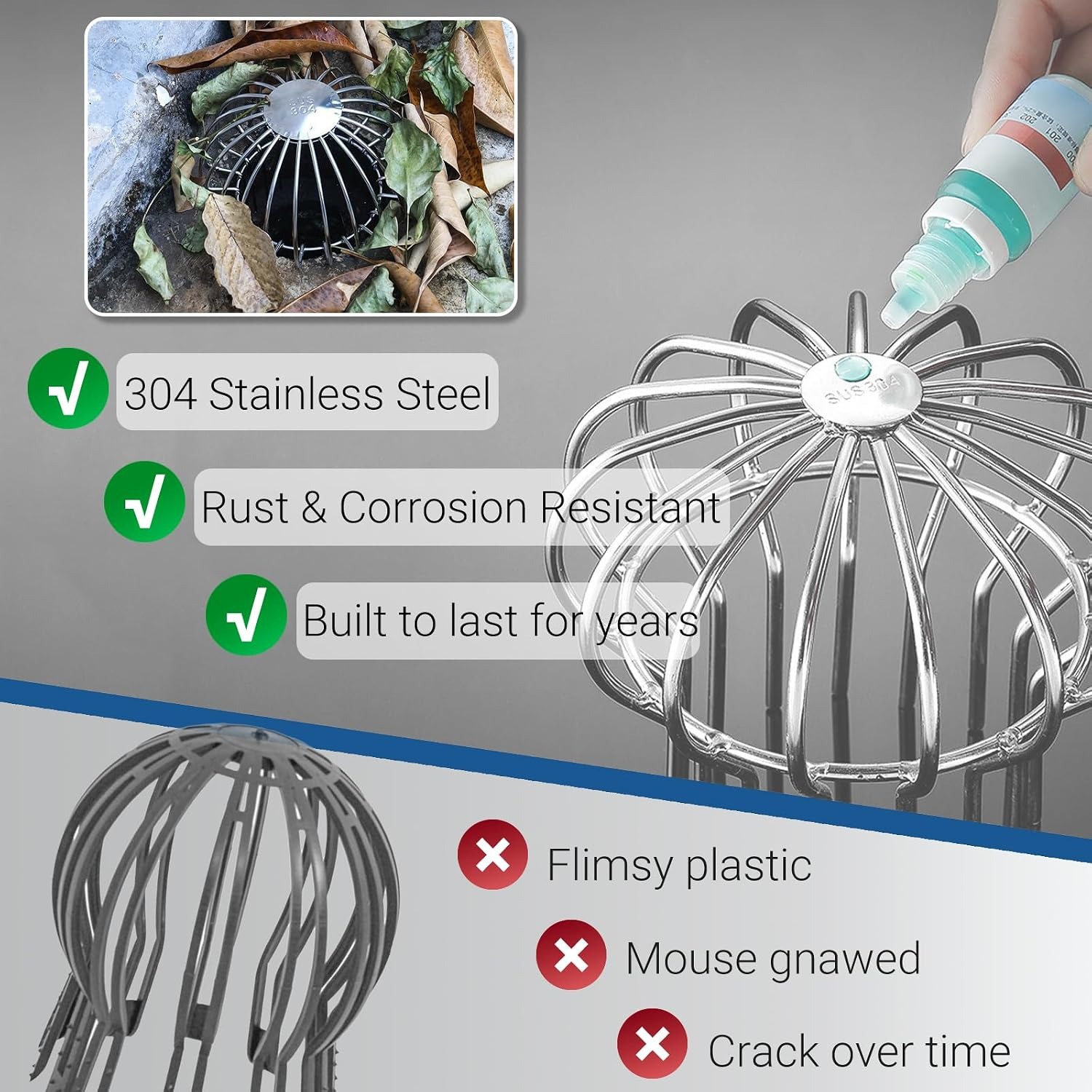
This particular guard is listed as 304 stainless steel. That grade turns up constantly in outdoor hardware for a reason.
Rainwater fittings live in a bad environment. Wet for days, dry and baking in between, with organic acids leaching out of rotting leaves sitting on top of them. Plain steel rusts through. Galvanised steel lasts longer but eventually the coating goes. Plastic holds up well for a while, then UV exposure makes it brittle and it cracks the first time someone leans on it with a gutter scoop.
Stainless steel in the 304 grade resists corrosion and oxidation without any coating to wear off. It stays flexible enough to handle being pulled out and pushed back in dozens of times over its life. It also keeps its shape, so the dome does not slowly flatten under the weight of wet leaves.
One honest note. In heavy coastal salt air, any stainless steel can develop light surface staining over years. It looks like faint rust spots but it is a surface film rather than real corrosion, and a wipe with a cloth usually sorts it out.
Getting the size right
This is the single most important decision, and it takes two minutes.
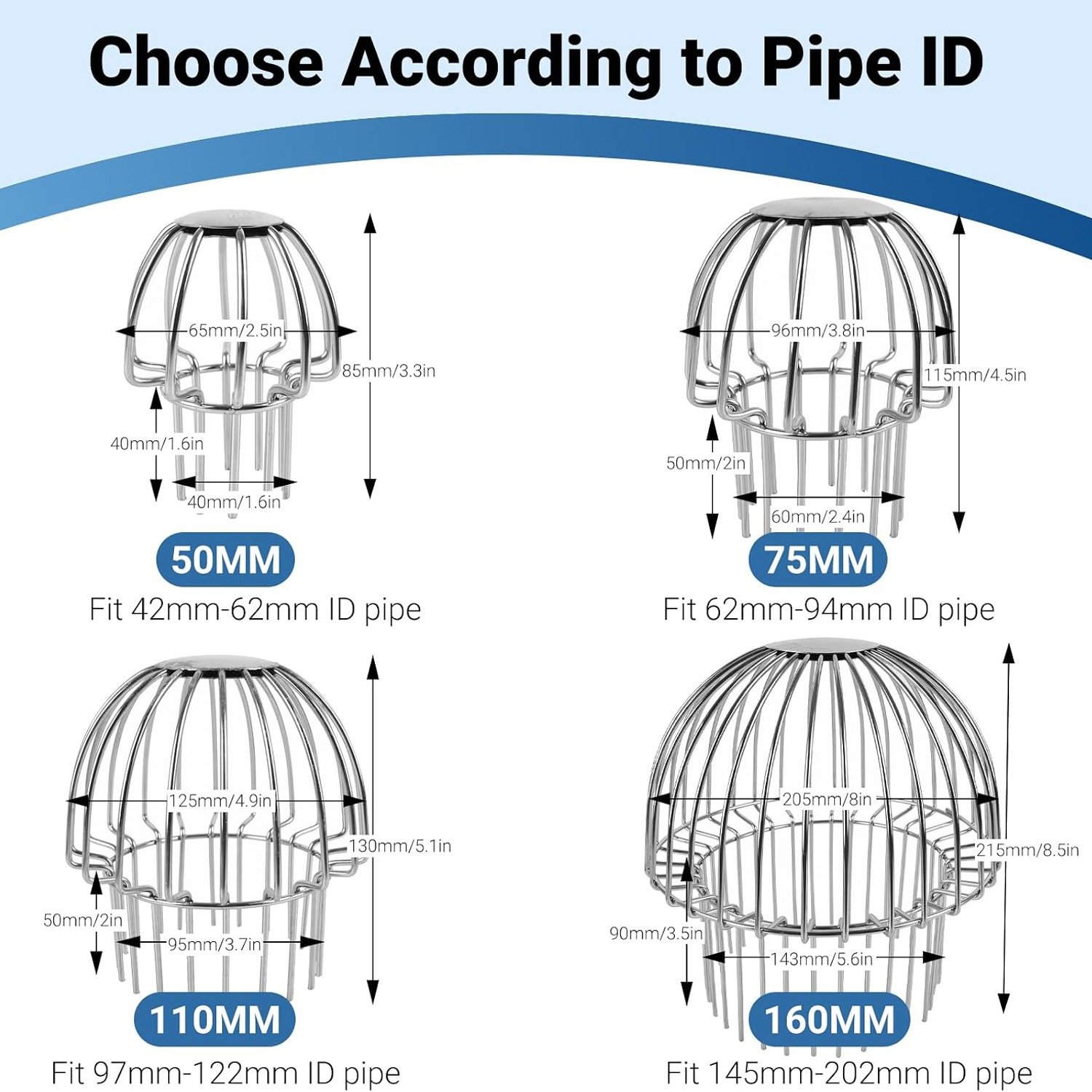
The listed size here is 42mm to 62mm, and that refers to the inner diameter of the opening the guard goes into. Not the outside of the downpipe. Not the nominal pipe size printed on a fitting somewhere. The actual hole.
Take a tape measure to the gutter outlet and measure straight across the inside of the opening at its widest point. If the outlet is a hole in the gutter floor with a dropper below it, measure the hole. Write it down, then check it falls in the range.
Two things go wrong when people skip this. A guard that is too small drops straight through and ends up at the bottom of the downpipe, which is worse than having nothing. A guard that is too large sits proud on top of the hole, rocks about, and lets debris slide underneath at the edges.
Also check the shape. These guards are round. If you have a half-round gutter with an unusual outlet profile, or a square outlet, the guard may simply not seat. It is worth a look before you order.
Who gets the most out of them
Houses with trees overhead are the obvious case. Gums, pines, planes, liquidambars and anything that drops constantly through the year will fill a gutter whether you like it or not. You cannot stop that. You can stop it reaching the pipe.
Two-storey houses are another strong case, because the cost of a blocked gutter there is not just the water, it is the ladder work. Anything that reduces the number of times you go up is worth having.
Rental properties and holiday houses benefit too. Nobody is checking the gutters weekly, so a passive barrier doing its job between visits has real value.
It is also worth fitting these on balcony and courtyard drains. Those drains are small, often tucked in a corner where leaves collect, and a blockage there means water pooling on a tiled surface that was never meant to hold it.
Fitting and first use
There is genuinely very little to it.
Clear the outlet first. If there is already a plug of compacted leaves in the pipe, fitting a guard on top of it achieves nothing. Pull the debris out, flush the pipe with a hose, and confirm water runs away freely.
Then press the guard into the opening until the flared rim sits against the gutter floor or drain lip. That is it. No screws, no sealant, no brackets.
Give it a test. Run a hose into the gutter for a minute and watch the water go down. If it drains at the same rate as before, you are done.
Keeping it working
The guard shifts your maintenance job rather than removing it, and that is the honest version. Instead of clearing a packed pipe with a wire or a blower, you lift a dome and shake it out.
Plan on checking two to four times a year. More often in autumn if you have deciduous trees, and after any big storm. The check takes seconds once you are up there.
To clean it, lift it out, tip off the debris, and hose it down. A stiff brush shifts anything matted into the mesh. Let it drip dry and push it back into place. Skip steel wool and abrasive pads, which scratch the surface and give dirt something to cling to.
If you notice water pooling in the gutter around the guard, that is your sign it needs a clean, not a sign that it has failed.
Pairing with other gutter work
A lot of people treat the best gutter outlet strainer as the cheap first step before deciding whether to pay for full-length gutter mesh. That is a sensible order to do things in. Fit the outlet guards, see how much trouble they solve over a season, then decide whether the gutters themselves need covering.
If you already have full gutter mesh, the outlet guard still earns its place. Mesh is rarely perfect at the ends and at valleys, and whatever gets through heads straight for the outlet. A guard there catches it.
The short version
A blocked downpipe is a cheap problem with expensive consequences. This guard is a small piece of 304 stainless steel mesh that drops into the outlet opening and stops debris getting into the pipe, while the domed shape keeps water flowing even when leaves pile on top.
Measure the inner diameter of your outlet first. This size covers 42mm to 62mm. Check the opening is round and not an awkward half-round profile. Order one per downpipe.
Fit it in seconds with no tools, check it a few times a year, and shake it out when it looks full. It is a small job that saves a much bigger one.